EN
Inspired by Virginia Woolf’s short text The Death of the Moth, the title of this exhibition, Wandering Moths, extends artist Belén Uriel’s long-standing concerns: the tension between manufactured objects of leisure and the bodies they are made for; the use of glass and metal to shape nearly organic forms; and the discreet poetry that emerges from the sphere of the functional.
Woolf’s text, a small moth beats against a windowpane, caught between the sheltered interior where the author writes and the expanse of the autumnal pastoral landscape outside, pregnant with energy — ploughmen and horses at work in the fields; a flock of rooks flying in unison in the skies. Although seemingly trivial in comparison, the moth’s struggle captures the author’s full attention and unfolds into a reflection on the inevitability of death and the fragile yet insistent vitality of life.
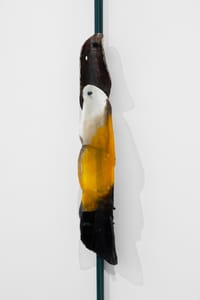
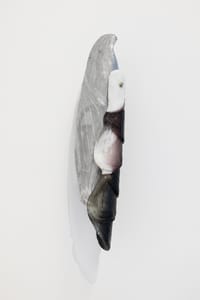
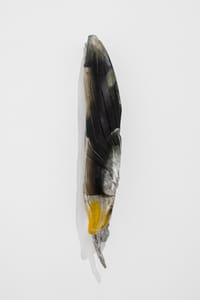
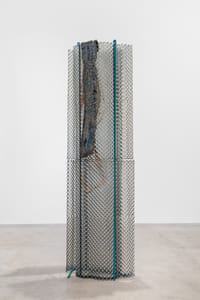
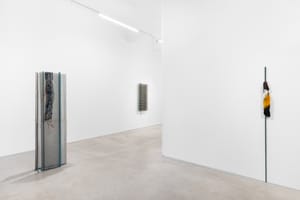
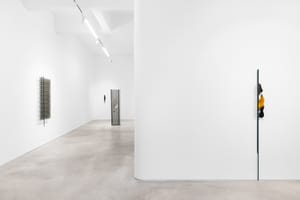
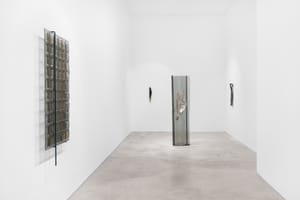
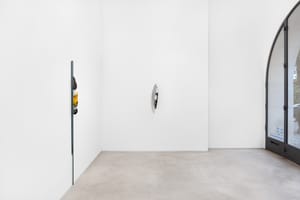
Akin to these themes, there is something existential about Uriel’s body of work, pertaining at once to the realm of death, to the feeling of being caught in a glass prison, and to the idea of watching the infinite possibilities of life from that limited vantage point. Hinting at nature and life- force, the uprightness of the sculptures shown in the gallery, as solemn steles or rising signs, as well as the relative solidity of the materials they are made from — aluminium, copper, iron, glass, and steel — bestow on these somber silhouettes a sense of strength and ascent. However, at the same time, their apparent rigidity is offset by the flickers of life these pieces tease us with from within. Some are reminiscent of organic forms or skeletons, as in Shell (fittings), for which, incidentally, Uriel turned off-the-rack backpacks inside out and used their internal frameworks as casts. Others, such as Insecta, resemble a moth or butterfly and present what look like modular articulations or exoskeletons — heavy, precious, yet fragile.
Uriel is known for working with mass-produced objects designed to support and protect the body outdoors: backpacks, helmets, sleeping bags, all unremarkable in their designs, unassuming and made solely for functionality. She transforms them — a gesture that has become part of her artistic lexicon — to give them a measure of soul through manipulations of form, as if the bodies they were made for had imprinted themselves onto them in return. Uriel’s vocabulary, however, extends beyond form. It operates through a series of subtle oppositions — between the mass- produced and the singular, the protective and the vulnerable, the cold inertness of metal and glass, and the warmth of lived experience.
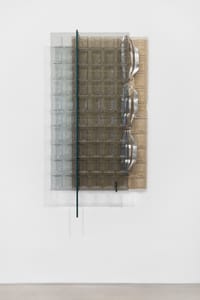
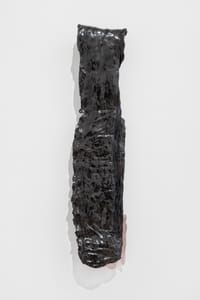
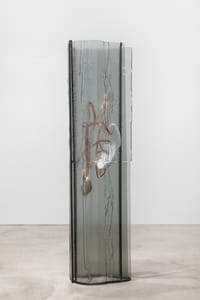
As such, the idea of temperature becomes one of the ways these tensions surface, not only as a physical property but as a concept of proximity, contact, and exchanged energy. As cool and somehow inhospitable as the sculptures’ surfaces appear, they are counterbalanced by the ideas they carry: comfort, living impulse, organic forms. In Back, for instance — the melted imprint of something that might once have hugged the curve of a human spine — echoes the holding and giving off heat in its melted-looking form. This sensitivity to material thresholds is also evident in the artist’s casting process. In Janela, for instance, what might resemble insect legs appears either trapped between two panels — recalling the moth caught on Woolf’s windowpane — or creeping from beneath them. For this work, and for the standing sculptures at the centre of the space, Uriel created casts from four different types of insulation panels. Her practice often involves probing variations within standardized products, exploiting the generic quality of consumer goods; yet, on the other hand, she lends them a new vitality through the sculptural operations she performs on them. The result is an uneasy tension between the banal and the poetic, where what is nearly invisible or insignificant becomes charged with an almost alchemical role — capable of transporting us to a different realm, journeying from neutrality to a kind of sanctification.
Drawing from materials central to Uriel’s practice and the themes she favours, the exhibition bridges the realm of leisure and the outdoors with the need for protection from its risks — including the risk of losing breath or life — honouring our bodies, and those of the small beings around us, for wanting to wander and explore life’s possibilities yet struggling in the process. In this series, the works seem surrounded by an aura reminiscent of amulets or funerary shells — forms of protection that also confine, carapaces that shelter even as they impede. These ambivalences echo the deeper uncanny dualities of Uriel’s practice: an attraction to objects that mediate between life and death, recreation and existentialism, the singular detail and the ordinary commonalities. What emerges is a sculptural language in which the nearly invisible leads us to consider our rituals, survival strategies and the symbolism we attach to them. Where a little moth — who cares — can throw us off and prompt us to ask the most fundamental questions about the very means of our existence.
Cristina Sanchez-Kozyreva
The production of the glass and ceramic pieces was possible thanks to the support of Unidade de Investigação VICARTE – Vidro e Cerâmica para as Artes.
PT
Inspirado no breve texto de Virginia Woolf, The Death of the Moth, o título desta exposição, Wandering Moths, amplia preocupações de longa data da artista Belén Uriel: a tensão entre os objetos de lazer manufaturados e os corpos para os quais são feitos; o uso do vidro e do metal para moldar formas quase orgânicas; e a poesia discreta que emerge da esfera do funcional.
No texto de Woolf, uma pequena mariposa embate repetidamente contra um vidro de uma janela, presa entre o interior protegido onde a autora escreve e a vastidão da paisagem pastoral de outono lá fora, carregada de energia — lavradores e cavalos a trabalhar nos campos; um bando de corvos a voar em uníssono pelos céus. Embora aparentemente trivial em comparação, a luta da mariposa capta toda a atenção da autora e desdobra-se numa reflexão sobre a inevitabilidade da morte e a frágil, mas insistente, vitalidade da vida.
Aproximando-se destes temas, há algo de existencial no corpo de trabalho de Uriel, relacionado simultaneamente com o domínio da morte, com a sensação de estar presa numa prisão de vidro e com a ideia de observar as infinitas possibilidades da vida a partir desse ponto de vista limitado. Sugerindo natureza e força vital, a verticalidade das esculturas expostas na galeria, como estelas solenes ou sinais ascendentes, bem como a relativa solidez dos materiais de que são feitas — alumínio, cobre, ferro, vidro e aço — conferem a estas silhuetas sombrias uma sensação de força e elevação. No entanto, ao mesmo tempo, a sua aparente rigidez é contrariada por lampejos de vida que estas peças insinuam a partir do seu interior. Algumas lembram formas orgânicas ou esqueletos, como em Shell (fittings), para a qual, aliás, Uriel virou mochilas comerciais do avesso e usou as suas estruturas internas como moldes. Outras, como Insecta, assemelham-se a uma mariposa ou borboleta e apresentam o que parecem ser articulações modulares ou exoesqueletos — pesados, preciosos, mas frágeis.
Uriel é conhecida por trabalhar com objetos produzidos em massa, concebidos para apoiar e proteger o corpo no exterior: mochilas, capacetes, sacos-cama, todos banais nos seus designs, discretos e feitos exclusivamente para funcionalidade. Ela transforma-os — um gesto que se tornou parte do seu léxico artístico — para lhes dar uma medida de alma através de manipulações da forma, como se os corpos para os quais foram feitos se tivessem, em troca, impresso neles. Contudo, o vocabulário de Uriel vai para além da forma. Opera através de uma série de oposições subtis — entre o produzido em massa e o singular, o protetor e o vulnerável, a frieza inerte do metal e do vidro, e o calor da experiência vivida.
Assim, a ideia de temperatura torna-se uma das formas através das quais estas tensões se manifestam, não apenas como propriedade física, mas como conceito de proximidade, contacto e energia trocada. Por mais frias e, de certa forma, inóspitas que as superfícies das esculturas possam parecer, são contrabalançadas pelas ideias que carregam: conforto, impulso vital, formas orgânicas. Em Back, por exemplo — a impressão fundida de algo que poderá um dia ter abraçado a curva de uma coluna humana — ecoa o ato de reter e emitir calor na sua forma de aspeto derretido. Esta sensibilidade aos limiares materiais também é evidente no processo de moldagem da artista. Em Janela, por exemplo, o que pode parecer patas de inseto surge preso entre dois painéis — recordando a mariposa retida no vidro da janela de Woolf — ou a emergir por baixo deles. Para esta obra, e para as esculturas de pé no centro do espaço, Uriel criou moldes a partir de quatro tipos diferentes de painéis isoladores. A sua prática envolve frequentemente a exploração de variações dentro de produtos padronizados, tirando partido da qualidade genérica dos bens de consumo; mas, por outro lado, confere-lhes uma nova vitalidade através das operações escultóricas que realiza sobre eles. O resultado é uma tensão inquietante entre o banal e o poético, onde o que é quase invisível ou insignificante se torna carregado de um papel quase alquímico — capaz de nos transportar para outro domínio, viajando da neutralidade para uma espécie de sacralização.
Partindo dos materiais centrais para a prática de Uriel e dos temas que privilegia, a exposição liga o universo do lazer e do ar livre à necessidade de proteção contra os seus riscos — incluindo o risco de perder o fôlego ou a vida — homenageando os nossos corpos, e os dos pequenos seres à nossa volta, pelo desejo de vaguear e explorar as possibilidades da vida, ainda que lutando no processo. Nesta série, as obras parecem envoltas numa aura que lembra amuletos ou conchas funerárias — formas de proteção que também confinam, carapaças que abrigam mesmo enquanto impedem. Estas ambivalências ecoam as dualidades mais profundas e inquietantes da prática de Uriel: uma atração por objetos que mediam entre vida e morte, recreação e existencialismo, o detalhe singular e a banalidade comum. O que emerge é uma linguagem escultórica em que o quase invisível nos leva a considerar os nossos rituais, estratégias de sobrevivência e o simbolismo que lhes atribuímos. Onde uma pequena mariposa — quem se importa — pode desestabilizar-nos e levar-nos a fazer as perguntas mais fundamentais sobre os próprios meios da nossa existência.
Cristina Sanchez-Kozyreva
A produção das peças em vidro foi possível com o apoio da Unidade de Investigação VICARTE – Vidro e Cerâmica para as Artes.
Artworks